
Seven Tests for a Data-Center-Ready Site
Executive brief
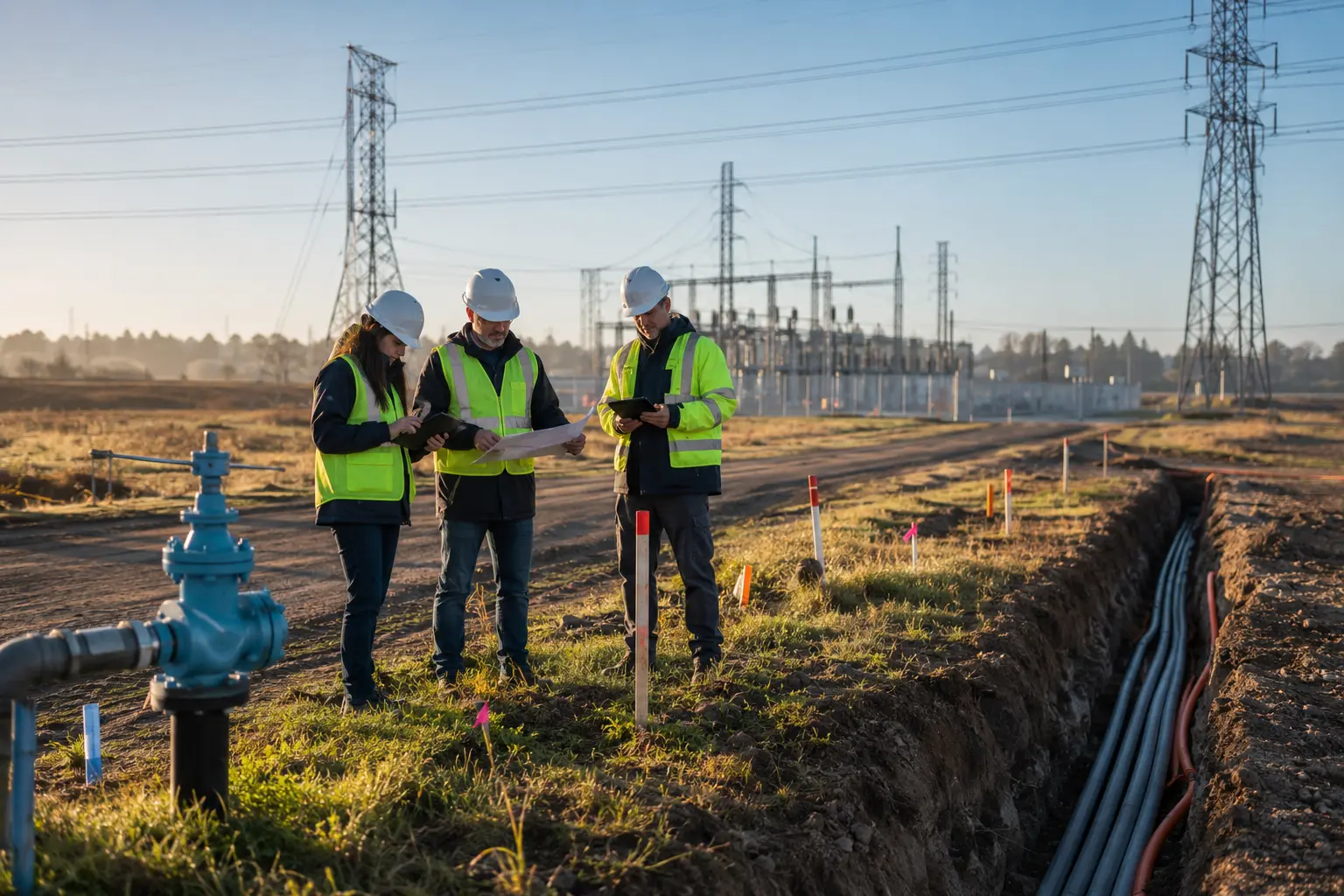
A parcel with a nearby transmission line is not automatically data-center ready.
Proximity is not capacity. Capacity is not deliverability. Deliverability is not schedule certainty. And none of those conditions alone establishes that a project can be permitted, financed, constructed, operated, and supported by its host community.
A credible site decision must integrate seven tests:
- Utility capacity and interconnection timing
- Redundant fiber routes
- Water and cooling strategy
- Flood, weather, and environmental exposure
- Zoning, permitting, and land-use control
- Transportation and labor availability
- Community impact and long-term operating fit
These factors belong in one decision model. Evaluating them separately can conceal conflicts that appear only when technical, financial, regulatory, and community requirements meet.
The objective is not to find a site without constraints. Such a site may not exist. The objective is to make the constraints visible early enough to be engineered, financed, mitigated, transferred, or accepted.
The resulting deliverable should be an executable readiness map. It should identify material risks, accountable owners, decision gates, dependencies, and a realistic sequence from diligence through commissioning.
The order matters. Land control before utility clarity can create stranded commitments. Design before water strategy can force costly revisions. Public engagement after decisions appear final can turn manageable concerns into durable opposition.
Read for decisions, not noise. A data-center-ready site is not merely attractive on a map. It is a location with a defensible path to operation.
What happened
Data-center site selection is often compressed into a short list of visible attributes: available land, access to power infrastructure, favorable tax treatment, and proximity to a major market. Those attributes matter, but they can create a false sense of readiness.
The transmission line visible from a parcel may not have available capacity for the proposed load. Even where capacity exists, the interconnection path may require studies, substation work, network upgrades, equipment procurement, easements, and utility approvals. Each requirement affects schedule and capital exposure.
The same pattern appears across the rest of the site.
A fiber map may show nearby infrastructure without confirming physically diverse routes, carrier availability, rights-of-way, latency requirements, or the risk of both routes sharing one vulnerable corridor.
A water source may appear adequate until seasonal conditions, competing demand, discharge requirements, cooling design, and public expectations are considered together.
Land may be correctly zoned while still facing conditional-use requirements, design standards, noise limits, building-height restrictions, environmental review, or political resistance.
A region may report an available workforce without demonstrating that the specific trades, operators, engineers, security personnel, and maintenance capabilities needed by the project can be secured on the required schedule.
The central problem is fragmentation. Each discipline can produce a technically accurate answer while the overall site remains unexecutable.
A utility team can confirm a study path. A network team can identify carriers. A civil engineer can describe grading and drainage. A land-use adviser can outline approvals. An economic development organization can present incentives. Yet no single answer resolves the interaction among cost, timing, dependencies, and public acceptance.
A site becomes ready only when those answers form a coherent execution path.
Why it matters
Data-center development is a systems problem.
The physical site, utility infrastructure, network architecture, cooling approach, entitlement process, supply chain, labor market, capital plan, and community relationship are interdependent. A weakness in one can alter the value of all the others.
That creates four forms of exposure.
First is schedule exposure. An uncertain interconnection date can undermine leasing assumptions, customer commitments, construction sequencing, and financing. A nominally lower-cost parcel may destroy value if it introduces years of avoidable uncertainty.
Second is capital exposure. Off-site infrastructure, utility upgrades, fiber extension, stormwater controls, road improvements, sound mitigation, and water systems can materially change the true cost of the site. The purchase price is only one line in the capital stack.
Third is operating exposure. A project that reaches commissioning without sufficient redundancy, resilient cooling, reliable access, or a sustainable labor base may carry persistent operational risk.
Fourth is legitimacy exposure. Communities evaluate more than promised investment. They consider land use, water consumption, noise, traffic, visual impact, emergency services, environmental effects, local benefits, and trust in the development process. Technical compliance does not automatically produce public confidence.
This is why early diligence must move beyond a pass-or-fail checklist. Leaders need to know which risks are fatal, which are manageable, which can be transferred contractually, and which require continued monitoring.
The best site is the one whose constraints are visible early enough to be engineered, financed, and explained.
Strategic implications
A disciplined readiness model should test the site across seven dimensions.
1. Utility capacity and interconnection timing
The first test is not whether power infrastructure is nearby. It is whether the required load can be served, on what schedule, under what assumptions, and with which upgrades.
Decision-makers should distinguish among stated capacity, studied capacity, reserved capacity, and deliverable capacity. They should examine the interconnection process, study dependencies, required facilities, long-lead equipment, cost allocation, redundancy expectations, and the credibility of milestone dates.
Power strategy must also align with phased development. A site that can support an initial phase but not the intended buildout may require a different campus plan, commercial model, or expansion strategy.
2. Redundant fiber routes
Carrier presence is not the same as network resilience.
A ready site needs a clear view of route diversity, physical entry points, rights-of-way, carrier options, construction requirements, and shared points of failure. Two services that occupy the same conduit, bridge, roadway, or regional corridor may provide contractual redundancy without physical redundancy.
Network requirements should be matched to the intended operating model. The question is not simply whether fiber exists. It is whether the site can support the required performance and recover from a credible disruption.
3. Water and cooling strategy
Water strategy begins with the cooling architecture, not with a generic statement that water is available.
Leaders should examine source reliability, seasonal constraints, competing uses, treatment needs, discharge conditions, backup arrangements, regulatory obligations, and community sensitivity. Cooling choices may trade water demand against energy use, capital cost, operating complexity, climate performance, and future flexibility.
The right answer will vary by site and design. The requirement is consistency. Cooling assumptions, utility plans, environmental review, operating economics, and public communication must describe the same project.
4. Flood, weather, and environmental exposure
Historical maps are a starting point, not the complete risk analysis.
The site should be evaluated for flooding, drainage, extreme weather, heat, wind, fire exposure where applicable, soil conditions, environmental constraints, and access during disruptive events. Leaders should also test dependencies beyond the parcel: substations, fiber routes, water systems, roads, and fuel delivery paths may face different hazards.
Resilience is not achieved by protecting the building while leaving its lifelines exposed.
5. Zoning, permitting, and land-use control
Correct zoning can reduce risk, but it does not eliminate entitlement uncertainty.
The review should cover permitted use, conditional approvals, setbacks, height, noise, lighting, generators, fuel storage, stormwater, environmental requirements, construction hours, road access, and any obligations attached to incentives or development agreements.
Land control should provide enough time to complete these investigations without forcing premature commitment. Option periods, extension rights, access for testing, and clearly defined diligence milestones can be as important as price.
6. Transportation and labor availability
Construction and operation place different demands on a region.
During construction, the project may require heavy-haul routes, staging space, contractor capacity, specialized trades, temporary workforce support, and coordination with other major projects. During operation, it needs reliable access and a sustainable base of technical, facilities, security, and maintenance personnel.
A labor analysis should test skills, availability, competition, training pathways, commute patterns, and retention. A broad regional workforce number does not answer those questions.
7. Community impact and long-term operating fit
Community impact is not a communications workstream added after site selection. It is part of site readiness.
Leaders should identify affected residents, public officials, utilities, emergency services, schools, workforce organizations, neighboring landowners, and other institutions. They should understand likely concerns and determine which can be addressed through design, operating commitments, infrastructure planning, or transparent explanation.
Promises should be specific enough to evaluate and restrained enough to keep. Trust weakens when benefits are overstated or tradeoffs are concealed.
What leaders should do now
Build one integrated decision model.
Each test should be scored against common criteria:
- Evidence quality: Is the conclusion supported by documentation or only by informal assurance?
- Schedule effect: Could the issue delay a critical milestone?
- Capital effect: What cost could arise, and who bears it?
- Operating effect: Could it reduce resilience, efficiency, or scalability?
- Approval effect: Does it alter permitting or political feasibility?
- Mitigation control: Can the project team control the response?
- Reversibility: Can the decision be changed later without severe loss?
Then classify each issue.
- Fatal constraint: The site cannot support the required project.
- Gating constraint: Work cannot proceed until the issue is resolved.
- Design constraint: The issue can be addressed through engineering.
- Commercial constraint: The risk requires pricing, contracting, insurance, or allocation.
- Monitoring item: The issue is acceptable but must be tracked.
Assign an owner, evidence requirement, resolution date, and escalation path to every material risk. A risk without an owner is not being managed. A date without a dependency analysis is not yet a schedule.
Use decision gates before major commitments:
- Gate 1: Initial site screen
- Gate 2: Utility and network feasibility
- Gate 3: Environmental and entitlement viability
- Gate 4: Concept design and cost validation
- Gate 5: Commercial commitment
- Gate 6: Construction authorization
- Gate 7: Commissioning readiness
Strategy must survive contact with reality. If new evidence changes the site’s risk profile, leaders should be prepared to redesign, renegotiate, pause, or exit.
The Poe Perspective
Good site selection is disciplined elimination.
The task is not to defend a favored parcel. It is to expose what must be true for that parcel to work.
That requires technical depth and executive restraint. Attractive incentives do not repair an undeliverable power schedule. A strong utility position does not cure a weak entitlement path. Available land does not compensate for fragile network routes. Community messaging cannot substitute for responsible design.
The seven tests create a common language for engineers, investors, developers, public leaders, utilities, and operators. They convert scattered diligence into a decision system.
Complex ideas. Clear direction. Real movement.
A serious readiness map should show where confidence is justified, where assumptions remain open, and where leadership intervention is required. It should make the next decision easier without pretending that uncertainty has disappeared.
Questions decision-makers should ask
- What power capacity is deliverable, by when, and under which documented assumptions?
- Which utility upgrades sit on the critical path?
- Are fiber routes physically diverse from end to end?
- Does the cooling strategy align with water availability, operating economics, and community expectations?
- Which hazards threaten the site’s external lifelines?
- What approvals are discretionary rather than administrative?
- What conditions could change after land commitment?
- Can transportation infrastructure support construction and ongoing operations?
- Is the required labor available when needed, not merely present in regional statistics?
- Which community concerns can be mitigated through design?
- Who owns each material risk?
- What evidence must be obtained before the next capital decision?
- Under what conditions would leadership pause or abandon the site?
Move from insight to implementation
PoeTech can structure a focused Data-Center Site Readiness Consultation around the seven tests.
The consultation should begin with the proposed operating model, load requirements, development phases, schedule, land position, and existing diligence. It should then integrate utility, fiber, water, environmental, entitlement, transportation, labor, and community considerations into one executive view.
The practical outputs should include:
- A site-readiness scorecard
- A constraint and dependency map
- A risk register with accountable owners
- Decision gates and evidence requirements
- A diligence-to-commissioning sequence
- Executive questions for utilities, carriers, public agencies, engineers, and landowners
- A prioritized action plan for the next major commitment
The purpose is not another collection of reports. It is decision clarity.
A focused consultation can help leadership determine whether to advance the site, redesign the plan, renegotiate terms, gather additional evidence, or stop before avoidable exposure grows.
Source notes
- This article expands the supplied Poe Knows draft, “Seven Tests for a Data-Center-Ready Site.”
- The draft establishes that proximity to a transmission line does not automatically make a parcel data-center ready.
- The seven evaluation areas are drawn directly from the draft: utility capacity and interconnection timing, redundant fiber routes, water strategy, flood and weather exposure, zoning, transportation, labor availability, and community impact. Transportation and labor are treated together as one readiness test to maintain a seven-test framework.
- The draft calls for these factors to be evaluated in one decision model.
- The draft defines the intended result as an executable readiness map with risks, owners, decision gates, and a realistic sequence from diligence through commissioning.
- No external statistics, project outcomes, client claims, or quotations have been added.

About the author
Rev. Dr. Gerald F. Poe Jr.
Founder and Chief Executive Consultant of PoeTech Global Consulting. Technologist, strategist, veteran, aviator, and cross-sector advisor with more than three decades of experience spanning AI, energy, sustainable data centers, telecommunications, UAS, healthcare innovation, public infrastructure, and venture development.